Tuesday, December 27, 2011

Open House at Wisma Duta with the Abresso Band


I attended the Open House at the Wisma Duta (the residence of the Indonesian Ambassador) on 26 December in Wassenaar. This was an annual celebration of Christmas for Christian Indonesians in the Netherlands, and featured short speeches by and recognition for a number of prominent members of the community; free food; and live music by the Abresso Band from Papua, as well as karaoke Christmas songs sung by locals. The event was held in a couple of tents set up in the Wisma Duta's back yard. A prayer service (which I did not attend) was held in the morning before the reception.

There were many Chinese Indonesians in attendance, some students, and a good number of Indonesian-Dutch couples and their children.

Searching around on line, the Abresso Band seems to be one of Indonesia's most celebrated reggae bands. It was flown in explicitly for this event at the Wisma Duta, though it will be doing one more public gig in Groningen later this week as well.

The band played well (I thought the bass player was particularly good) but was hardly 'hard core' reggae and happily played Christmas numbers (some accompanying local singers), poco-poco and the like.

Also announced was the name of the new ambassador to Den Haag, Retno Lestari Priansari Marsudi, best known as the investigator charged with looking into the death of human rights activist Munir in the Netherlands in 2004. In interviews, Retno Marsudi talks about herself as a true Javanese who listens to gamelan music to unwind. Let's hope she also supports Javanese arts when Ambassador.

Saturday, December 24, 2011

Teeuw Prize Award Ceremony


Elsje Plantema, the Amsterdam-based gamelan teacher and performer, received the Professor Teeuw Award 2011 for her contributions to Dutch-Indonesian musical exchange. Past recipients of this award include Indonesian writer Goenawan Mohamad and F.X. Suhardi Djojoprasetyo, a gamelan performer and teacher attached for many years to the Indonesian embassy in the Hague.

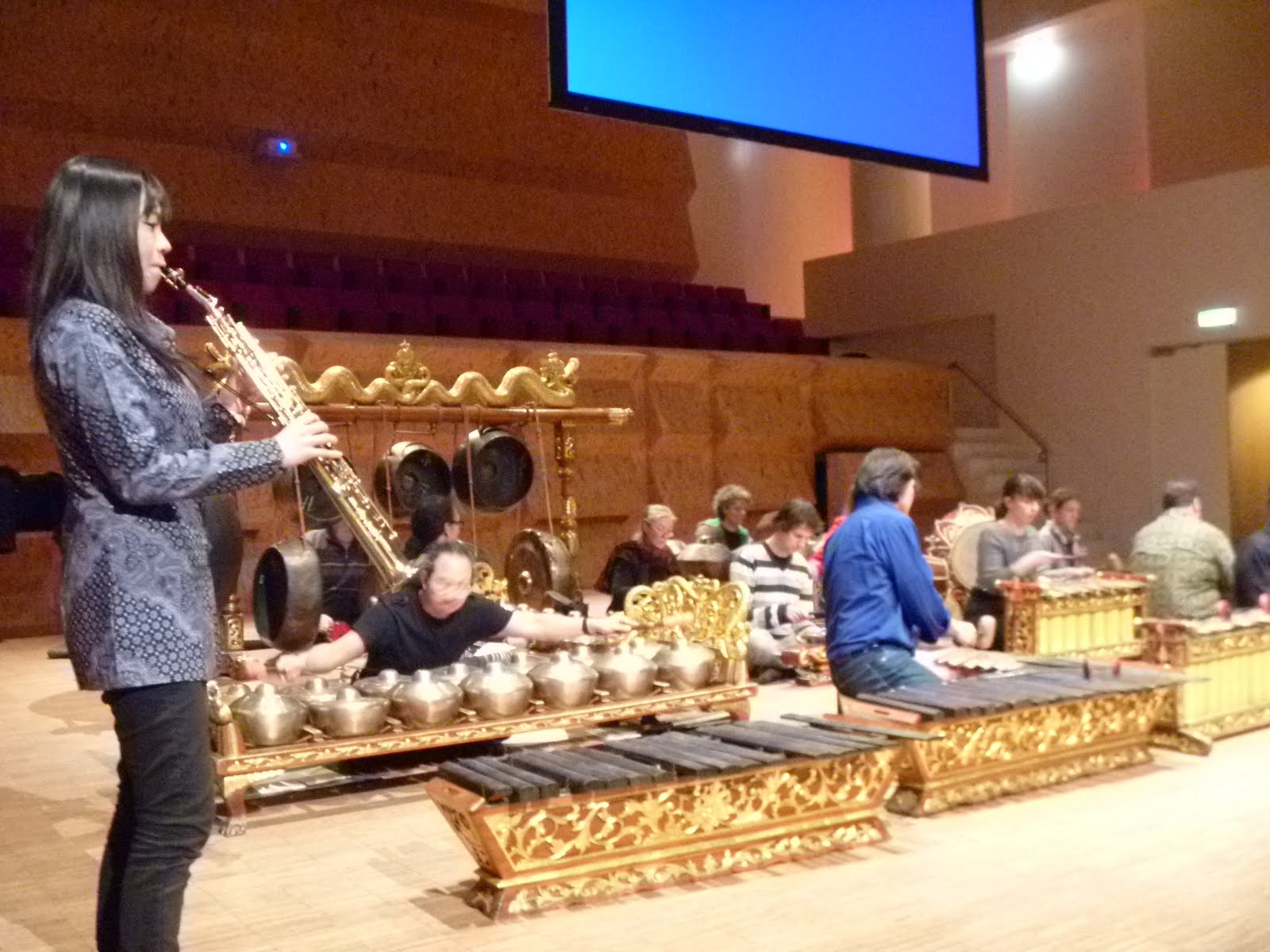
The prize ceremony for Elsje Plantema took place at Amsterdam's musical conservatory on 21 December. Two of the gamelan directed by Elsje played pieces by Nartosabdho and Lou Harrison (see http://www.youtube.com/watch?v=C0GNaHX2iz0&list=UUiBzyz9zXadZxAg_kyL1FRw&index=2&feature=plcp), Lutgard Mutsaers (author of a book on Indo-Rock, and also a forthcoming book on keroncong) delivered a laudatio, and I presented an illustrated lecture on gamelan in Europe (drawing on my book Performing Otherness, as well as a couple of other recent or forthcoming publications).

The highlight for me I think was saxophonist Yukari Uekawa and Gamelan Mugi Rahayu playing Harrison's A Cornish Lancaran)- pictured above. I spoke to Elsje after the event and she said that the soloist was a former gamelan student of hers at the Conservatorium. Much of the sax part is improvised, and Elsje attributed the success of Yukari's rendition to the player's understanding of gamelan structure (particularly the use of seleh notes).

'High tea' was served after the formal presentations were over - which meant cakes and tea.

It was very nice to meet up with gamelan folk from around the Netherlands, and the event had a very celebratory feel to it. My own talk was nicely received- good publicity for the book, and a way of giving something back to a community of interest which supported it.

Tuesday, December 20, 2011

Karo-begrafenismuziek, Louis Couperus Museum, Den Haag


Juara Ginting's Karo Leiden-based Karo group of musicians and dancers, joined by guest artist Pulumun Ginting from Medan (part of a contingent of PhD students from Indonesia currently working on PhD proposals in Leiden, backed by the Kajian Tradisi Lisan and the KITLV) offered a suite of pieces from Karo death rituals at the Louis Couperus Museum in The Hague on 17 December 2011 in conjunction with an exhibition on death and funerals (http://www.couperusmuseum.org/press_d.html).

What started off as a piece of sandiwara, with very theatrical declamations from Juara backed by mannequins of Dutch mourners in the museum exhibition (on loan from the National Theatre), transformed over the course of the event into a heartfelt expression of grief. This was perhaps due to the utter conviction of Nelly, the principal female singer and dancer of the group, who runs the Sumatra House eatery in Leiden. Nelly's niece, Tari (who has taken time out of her studies in Medan to work at the eatery for a few months, returning at the end of the month), said she felt a bit 'grogi' in this unusual setting.

I spoke to Juara afterwards and he admitted to being very moved by the experience. He noticed that I did not really clap after each of the pieces - which involved surrogation (a piece of cloth for a dead child?), confession, crying, ecstasy, maybe even possession. Indeed I admitted it was hard to know how to react to this performance, I told him, but I felt very moved. This made it a 'sukses' as a piece of art (seni) he said.

The museum is very small, and the performance was full to capacity. A glass of wine was available afterwards.

Saturday, December 3, 2011

Kajian Tradisi Lisan "Workshop"


I attended a presentation on Friday (2 December 2011) of the Kajian Tradisi Lisan researchers who are spending 3 months in Leiden. Most of them are PhD students who are developing their proposals, and are working in many areas - from ruwatan, to death ceremonies, oral poetry etc. -- in cultures and societies around the Indonesian archipelago.

The group of 20-25 students and lecturers delivered what was billed as a 'workshop' at the dance studio of the LAKTheater of Leiden University to an audience of about 40 to 50 people. The event was facilitated by Clara Brakel, a researcher who also heads up a Javanese dance troupe, Kuwung-Kuwung. On offer was a short solo kentrung performance, jaipongan and Balinese dances (which I had seen previously in Den Haag),lagu Ambon and what was definitely the highlight of the event - a series of Karo Batak songs and dances that brought together two very talented musicians from Sumatra; the owner of Sumatra House, a local eatery, and her niece; supplemented by members of Kuwung-Kuwung who played a number of musical instruments.

After the performance, which lasted about 90 minutes, there was a nice social event upstairs with tea and vegetarian lumpia, a chance to meet and greet.

Thursday, November 24, 2011

Iwan Gunawan Lecture-Demo


I attended last night a lecture-demonstration by Iwan Gunawan, a Bandung-based composer and director of the contemporary gamelan ensemble Kyai Fatahillah. Iwan is in the Netherlands for two months working together with the Dutch dance company LeineRoebana on a piece titled Ghost Track which explores the Indonesian heritage of the company's co-director the Dutch-born Harijono Roebana. Ghost Track, which premiered in Breda on 18 November will tour the country until 23 December.

Iwan spoke at length about his compositional methods, and also played a number of videos of his work (which combines gamelan with electronic music) and a few sound recordings. He also played a few pieces together with his group's sinden Endang and a suling/ tarawangsa player. (There are 7 members of Iwan's group performing in Ghost Track, along with 3 dancers from Solo.)

Iwan is a traditionally-trained musician, with experience in wayang golek, Cianjuran and calung. He studied music in university with Dieter Mack, who introduced him to the word 'contemporary'. Iwan's university studies also introduced him to the use of musical notation for composition, but after graduating he found that there were no musicians who could play his work, so he write music for his students who make up the members of his group Kyai Fatahillah.

He says he does not write for Sundanese, Javanese or Balinese gamelan but rather for gamelan generally. He tends to use central Javanese instruments (often combining slendro and pelog in one piece) but derives techniques from all 3 of these gamelan traditions. He is interested in exploring the sounds of gamelan. Sometimes this involves using a bow on percussion instruments, sometimes placing a gong on the floor rather than hanging it from a stand, sometimes experimenting with damping techniques. He references traditional forms; for example the electro-acoustic piece Fonem (http://vodpod.com/watch/1301908-fonem)refers to wayang golek conventions in different ways. But he wishes to be able to have more control over intensity and dynamics than is traditional.

Over the last years, he has arranged and performed Steve Reich's Six Marimbas (1986) both with his own group and also Ensemble Gending, a Dutch gamelan group, for 7 and 13 players. He said what drew him to this piece was not Reich's minimalism - Iwan already knew about minimalism from gamelan - but rather Reich's techniques for musical development. This work has been performed here in Holland the international gamelan festival in Amsterdam, at Salihara in Jakarta, and also in Berlin.

The collaboration with LeineRoebana was sparked by a chance meeting with the company's co-director Harijono Roebana in Amsterdam in 2010. Roebana was interested in exploring his Indonesian heritage together with Iwan. Iwan approached the project with trepidation as he had not worked with a European choreographer before. He feels that the grounds for any collaboration is mutual respect, and wanted to make sure that their work together would be sensitive to cultural issues. Additionally Roebana wanted to 'use' traditional music in the work, and Iwan was not sure that he could do this in an ethically sensitive manner - one cannot just 'put' tradition into a contemporary frame.

Iwan and LeineRoebana sent materials (music, videos of past dance work) back and forth by email over some months, discussing their artistic philosophies as well. Then Roebana travelled to Indonesia where he worked intensely with Iwan over some weeks and auditioned dancers in Solo and did some initial exploratory workshops. Then Iwan and the Indonesia dancers and musicians spent 4 weeks in Holland for rehearsals. The piece was performed in Jakarta before its official premiere in Breda (where LeineRoebana is a company in residence).

Iwan said that some of the pieces in Ghost Track were already written, others especially composed for the work. Some parts are improvisational, others precisely notated. In rehearsal he found that sometimes he could create something with his musicians on the spur of the moment, but other times he needed to work out a score by himself in the privacy of his own room working on his computer. In Indonesia, Iwan said, music is like the weather, never completely predictable. In Europe he has observed everything needs to be fixed in advance.

This is not a bad thing, for Iwan at least, who creates music with notation (and has therefore sometimes been accused of being 'too Westerern' kebarat-baratan). For in Indonesia, when he has worked with dancers, they 'feel' the music but don't understand it intellectually. For example they are unable to identify shifts in meter.

As both Iwan and LeieneRoebana's dancers and choreographers understand metrical structures, there is a ground for communication.

In the lecture demo I enjoyed particularly hearing Iwan's sinden Endang (who trained with the late Euis Komarah) sing a solo, an improvisation by one of Iwan's musicians involving multiphonics and words spoken through a suling, and a lovely Cianjuran number (pictured above).

I look forward to seeing Ghost Track when it plays at Leiden's LAKtheater this coming weekend.

Sunday, November 6, 2011

Pasar Kliling and Pasar Malam Rijswijk


Yesterday (5 November 2011) I attended the Pasar Malam Kliling, an annual celebration organized by the Javanese-Surinamese cultural association Stiching Manggar Megar, followed by the Pasar Malam Rijswijk. The former took place in a community hall in Den Haag, the latter in an expo centre in the adjacent town of Rijswijk.

The Pasar Kliling was essentially a community event with a focus on cultural acts of members and friends of the Surinamese Javanese community - we saw a Surabaya-born singer named Melani perform karaoke covers of popular Indonesian and Western songs, a cross-dressed belly dancer who brought out two remarkably big snakes and invited audience members on stage, street dance by girls of Javanese descent, jaipongan and a Balinese dance (Tari Tenun) performed (to CD) by two students of tradisi lisan who are spending 3 months in Leiden developing their PhD proposals, a fashion show of old Surinamese creole costumes, and a warrior dance (wireng) and bedaya performed to live gamelan accompaniment under the direction of Bp Suhardi Djojoprasetyo (pictured above). Surinamese food (ginger beer, bara, nasi and bami goreng, sate etc), Javanese DVDs and CDs, Hindu religious paraphernalia etc were for sale. At the entrance was a box where people could offer an optional monetary donation. I bought a recent DVD of Mantjes House Band- one of Suriname's best known Javanese pop bands from a Surinamese-Javanese vendor after consulting with him in low Javanese. (He thanked me for the purchase with a friendly 'kesuwun'.)

The Pasar Malam was more commercial in orientation. Entry was 8 Euros at the door. There were two podiums for performance, and perhaps 100 stands selling various wares and services (Buddha statues, Thai massages, wayang golek puppets) and the normal sorts of food one buys at pasar malam in the Netherlands (I had reasonably good es tape, pisang goreng and kelapa muda). The pasar was fairly quiet when I arrived (at 6pm or so) but the podium where a karaoke singer named Dewi Mass did poco-poco songs and Whitney Huston covers and a band called Band Marabunta was thronged by dancing spectators. I enjoyed chatting with a book vendor (from whom I purchased, among other items, Wajang Foxtrot, a beautiful catalogue of a 2011 exhibition in Rotterdam of sheet music covers from the Indies with an accompanying CD).

All in all, a nice day out.

Thursday, November 3, 2011

Indonesian arts in the Netherlands


I'm a fellow this year at the Netherlands Institute for Advanced Study and spending the academic year living on campus in the village of Wassenaar (located between Den Haag and Leiden). It is an interesting time, as they say, to be back in Holland (I was a postdoc at the IIAS in Leiden in 1998-2000), with many of the main supporting institutions for Indonesian studies and theatre under attack by government funding cuts.

Nevertheless, there is still lots that I've been able to attend. A Pesta Rakyat dan Bazaar Makanan dan Produk Indonesia (pictured above) at the Sekolah Indonesia in Wassenaar - a replacement for the annual Hari Merdeka celebrations(10 Sep), an academic symposium Recording the Future sponsored by the KITLV (6 Oct), a touring production from Yogya-based choreographer Martinus Miroto 'Di Belakang' (6 Oct at the Korzo Theatre in Den Haag), a major exhibition on colonial Indonesia and culture at the KIT (23 October), a workshop on Colonial Nostalgia at the KITLV (27 October).

Now that I've settled in, and my camera is working properly, I hope to be able to offer more detailed impressions of some of the events I attend.