Wednesday, February 13, 2019

Gamelan Ibu-Ibu in a Nineteenth-Century Javanese Manuscript


It has been some time since my last blog post - but this one is too good not to post on Indonesian Performance. Thumbing through Yale University Art Gallery's small collection of Indonesian manuscripts today, I ran across this illustration in a nineteenth-century wayang manuscript: an illustration of a gamelan ibu-ibu. In this double-page spread, a group of 5 women are playing kendang, rebab, peking, gender, and gong/ketuk. There are also two more saron-type instruments that have no players at them. All of the musicians are dressed in the same uniform - with blue skirts, the same armlets and hair decorations etc. And a couple of pages later two of the female musicians appear again in an illustration, carrying what appears to be the rancak (frame) for a bonang.


Illustrations of gamelan playing in manuscripts of this period are not common, let alone an all-female group. More research is clearly needed!

Further information on the manuscript (ILE2014.8.26), which entered Yale's collection in 2014, is at https://artgallery.yale.edu/collections/objects/181348

Tuesday, November 29, 2016

Collaborating Balinese Gender Wayang and Shadow Puppetry at SOAS, 27 November 2016

After a hiatus of more than 2 years, I am finally prompted to return to blogging. It's not that I haven't seen or been involved in Indonesian performances worth blogging about - far form it - but I have been overwhelmed with other things. (Not least our baby Leah.)

On Sunday night 27 November we attended an evening of new compositions for Balinese gender wayang with accompanying shadow puppetry performed by the Berlin-based puppet maker and puppeteer Herlambang Bayu Aji.


This event, organised by the London-based musician and composer Aris Daryono, was the latest in a series of annual concerts of new work for gamlean. While in past years concerts have involved only Javanese instruments, this year it took the form of work for gender wayang, played by Nick Gray and friends. Unusually also, this year there was a wayang element, with Mas Bayu flying in from Berlin to rehearse with the ensemble and some of the composers.

I spent a day hanging out with Mas Bayu, visiting museums in London and talking wayang. He had worked with Mas Aris in Berlin in the past and was brought in to put together a contemporary play using puppets and ideas developed for past performances in Germany on the themes of ecology and refugees. One of the conditions was that the play could contain no dialogue or narration or text of any sort - the focus had to be kep on the music - which he said was quite a challenge.

The performance, as in other recent performances of Mas Bayu in Germany, involved a combination of live shadow puppetry (using Wayang Rajakaya puppets made in Solo from buffalo hide around 2010 and black cardboard puppets made more recently in Germany) and projected images and simple animations.

The highlight for me was the final scene set in London - indicated by the projected image of the Houses of Parliament and Big Ben. To a score by my old friend Simon van der Walt of monotonous clock-like ticking (one gender beater against the other) and big unison chords (reminiscent of the chiming of a clock) the refugee animals arrive one by one before the desk of a bureaucrat who is scribbling away, They entreat him but one after the other they are shooed off, and wait in a line for him to respond.


At a post-performance discussion (which we had to leave early as it was way past our daughter's bedtime, Mas Bayu was asked about the narrative, He was initially resistant to supplying his understanding of the story, giving the standard answer that every person could make a story as they please. But he eventually broke down and related how this was the story of animals displaced from their natural environment who take refuge in a city already over-crowded with refugees. One of the more unusual puppets was a tiny airplane. I, for one, could not possibly have guessed this was a vehicle engineered by the animals so they could travel to the metropole to plead their case! Mas Bayu was asked how the story ended. He said that he would leave that up to the imagination of each spectator.

Sunday, August 31, 2014

Rastika, RIP


I have just been informed by a friend from the town of Gegesik that the great pelukis kaca (painter on glass) Rastika from Desa Gegesik Kidul (Cirebon, West Java, Indonesia; pictured above in a photo taken in front of his sanggar in 1993) passed away this weekend.

Rastika is considered to be one of the key figures in the revival of the craft of lukisan kaca (reverse painting on glass) in Indonesia in the 1970s and 1980s. His colourful and lively work was grounded in a deep knowledge of the wayang kulit tradition, the product of a long apprenticeship with the Gegesik puppeteer Ki Maruna.

One of the breakthroughs he is associated with is the transformation of lukisan kaca from an art form for mystical symbolism and the depiction of individual wayang figures (wayang ijen) to the representation of scenes from wayang kulit, above all the Bharatayudha (or Prang Jaya as it is known in the Gegesik wayang tradition). For this he drew upon the bramakawi illustrated manuscript tradition, of which Ki Maruna was probably the last living master. Rastika also applied his technical mastery of the medium to the depiction of everyday life, including a series of paintings commissioned by Kompas.

Rastika was a regular participant in national festivals and exhibitions and his work was highly sought after by collectors. With the rise of lukisan kaca prices in the late 1980s he was able to support other artists around him in Gegesik,particularly in the field of wayang, gamelan and topeng.

He will be missed by many.

Monday, July 14, 2014

Wayang in the British Museum


It's been a long time since my last blog post - almost exactly a year in fact - and I think it is high time for me to get back to blogging. This inactivity has been due largely to pressing other needs, but also on focus on non-Indonesia matters.

The last weeks though have seen me return to the world of wayang kulit through a series of visits to the stores of the British Museum, where I have been looking at shadow puppets from Java, Bali, Thailand, and Malaysia with visiting puppet experts, including Professor I Nyoman Sedana (pictured above looking at a nineteenth-century Balinese bark cloth-on-rattan figure used for cremation ceremonies) from ISI Denpasar.

Alexandra Green, the museum's Southeast Asia curator, and I have an exhibition proposal on Asian shadow puppets under consideration and we are hoping to develop an AHRC bid around this. The visiting experts (five of them so far) have been working with us in developing a research methodology in how to work with shadow puppets in museum contexts.

Alex has been thinking about the history of collecting in relation to this -- why are certain figures chosen over others - as well as the history of cultural interactions which take form in shadow puppets. (She has some fascinating insights into the use of Indian trade textiles on the Raffles figures from early nineteenth-century Java.) I have been thinking about how puppeteers imprint their dramatic imaginations on these static figures from another time, and what sorts of historical and practical information can be evoked in the encounter with museum objects.

There is still a long journey before us....

Monday, July 8, 2013

Gamelanathon


Last weekend (6-7 July) was the Gamelathon, described as 'a weekend of Indonesian music, dance and puppetry across the Southbank Centre site' in London. This was a pretty huge event, organised by Sophie Ransby, with free performances by performing groups from around the UK and Ireland, along with a ticketed dance piece by Indonesian-Australian choreographer Ade Suharto ('In Lieu') and a major programme by the Southbank Gamelan Players featuring srimpi, small dance pieces and a so-called sendratari titled Topeng Panji Kayungyun. Performances took place in the Clore Ballroom at the Royal Festival Hall, outdoors on a temporary stage erected on the Riverside Terrace, the Front Room at Queen Elizabeth Hall, and in Queen Elizabeth Hall itself.


I was busy with my own performance, Dewi Gegurit, a new wayang golek cepak play which built upon my studies in Cirebon and Indramayu in 2012, which I created in collaboration with Indonesian composer/pianist Marisa Sharon Hartanto. But I  managed to see in full or in part quite a bit of the rest of the festival-- the end of a concert by Gamelan na Gaillimhe from Galway, Ireland; a combined concert of Sekar Enggal and Royal Holloway's own degung ensemble Puloganti (plus some Cianjuran thrown in) under the direction of Simon Cook; a number of pieces by the UCC Gamelan of Cork University (Ireland); the big sendratari and dance concert by the Southbank Gamelan Players with guest artists from ISI Solo; Lila Cita and Lila Bhawa's exciting programme of Balinese gong kebyar and dance; new music and old classics by York University's Gamelan Sekar Pethak and friends; a walkabout show called Ramayna on Stilts; Southbank Centre Intermediate Gamelan Players plus a few dancers; Ade's show In Lieu; and a short wayang kulit play Sakuntala performed by Sri Suparsih (who is also a well known sindhen) with Siswa Sukra and friends.


I didn't get to the puppet making workshops, and sadly missed the gamelan & electronic music concerts (I was really hoping to attend particularly the set with compositions by Charles Matthews, who is off for another year in Java shortly) and also missed a performance given by the Labschool from Cibubur, Jakarta. (Though I did see the kids and their teachers walking around the Southbank dressed in Srikandi t-shirts.)


The whole event had a glorious community feel to it. Musicians floated in and out of each others' sets, with the guest artists from ISI Surakarta dancing, playing music, singing, performing wayang etc in many of the performances. It was delightful to see the same musician playing Sundanese rebab in one set and Javanese gender in another, or Balinese drum followed by Javanese bonang etc.  I was sitting in the audience watching one concert and the musicians faltered on a classical Javanese piece and  a friendly musician commented to me 'I really should have been on stage with them for that' and in the next number she was up there helping out. Casual passerbys and children wet from the Southbank's fountain installation were drawn in, and I drank a Pim's from an outdoor bar while waiting for one of the shows to begin.


The highlights for me were really too numerous to mention. But they definitely included an extraordinarily beautiful Srimpi Ludiramadu which opened the Saturday night Sendratari big concert (with Ni Made Pujawati taking one of the 4 dance parts and remarkably holding her own against 3 very seasoned Javanese dancers), a raucous and fun piece for saxophone and gamelan by the UCC Gamelan (who played so loudly that they reportedly broke a slenthem key!), a fantastically precise and involving one-person barong performance (barong buntut) accompanied by Lila Cita, a very amusing arrangement of The Rite of Spring to celebrate the 100th anniversary of the ballet by Sekar Pethak and the beautiful dancing of Wasi Bantolo (the choreographer who led the dancers from ISI Surakarta, pictured above). 


I also of enjoyed Sri Suparsih's wayang performance (above), which retold the classic story of Sakuntala, abandoned pregnant in the forest by a king she has nursed back to health, who travels to see the king after 16 years to make him come through on his promise to admit their child as his own. I was surprised though that she did not inject a more feminist interpretation into the story, and that no programme notes were offered to assist audience members in following the Javanese dialogue.  


My own contribution to the Gamelanathon was a short wayang golek cepak play titled Dewi Gegurit which I created together with the Indonesian composer Marisa Sharon Hartanto, who is studying for an MA in music composition at Royal Holloway. The play tells the story of a newly-divorced Raden Gambuh  (Sir Puppeter) who is in search of a new wife, a woman of culture. At the advice of his grandfather, he travels to the kingdom of Nyugoni to seek the hand of the beautiful princess Dewi Gegurit (Lady Song) who also desires a man of culture. She requests that he find a wayang and after some trials he decides with the help of the clown Lamsijan to become a dalang himself. Unable to locate a gamelan, Lamsijan and friends play the accompanying music on Western instruments. 

The play is of course allegorical, and in some ways follows up my earlier solo performance A Dalang in Search of Wayang (in which I quest in the mythical world of wayang for an answer to the dilemma of how I can be a dalang without a gamelan or a Javanese audience or sponsoring communities) and Lokananta, which concerns the origin and development of gamelan and was performed in York University with more than 200 accompanying musicians in 2012. 


The play used figures from Indramayu left in the UK by Ki Akmadi after his AMC-sponsored tour of 2005, and featured an ensemble of piano, voice, flute, drums and doublebass all performed by RHUL music students.

Dewi Gegurit generally seemed to be well received. One friend commented on Facebook about its 'Fantastic score [played] by some very gifted RHUL musicians that made western instruments sound pretty Sundanese', another friend said how pleased he was that both the contemporary and the traditional found their balance in the piece, both in terms of drama and music. An older woman, the mother of another gamelan composer involved in the event apparently, seemed less pleased however- she said she was not convinced by the pop songs we included (particularly in the clown scene) though, rather strangely, she said she was sure that this was not my worst performance. Another friend, a puppeteer who happened to be passing through the Southbank, said he would have preferred more movement during the dialogue.Probably the nicest written comment I received was from a former student who said it was 'a lively performance [with an] amazing singer and full of joy.' Another friend, commenting on one of the Facebook pictures I posted, also said the image 'captured the joy of the moment'.

If I did indeed succeed in maintaining the Gamelanathon's overall mood of joy, I think I probably did a pretty good job for my first wayang golek cepak performance in the UK. Hopefully there will be more to come.

Tuesday, July 2, 2013

Wayang at the Museu da Marioneta, Lisbon


I was at the Museu da Marioneta, Lisbon's puppet museum, today to see their permanent exhibit. While there was nobody on hand to give a personal tour, the galleries were well laid out and there was a good English-language audio tour on offer. The exhibit charts the course from the traditional puppet traditions of Asia and Africa to European popular puppets (pupi, Guignol, Dom Roberto, Punch etc) to the modern puppets of Portugal (fairground puppets, puppets for education, the revival of Da Silva's puppet operas in the 70s and 80s etc), ending with a room devoted to stop motion animation.

Wayang was represented by three sets of figures - a set of nice old wayang golek purwa puppets from Sunda; a set labelled wayang golek cepak but which looked to me more like wayang thengul figures; a smaller set of wayang kulit purwa from Surakarta displayed in silhouette. The wayang thengul were interesting for me in part because of the Menak Jinggo puppet, which has a head which is a bit gepeng (flat), suggesting the origins of the form in wayang krucil.  (See above.)

More effort could have been made to show that Asian puppet traditions continue to evolve, just as European ones do. But this is in part an artefact of the collecting process. The museum is based in a convent owned by the city but most of the collection is privately owned. The woman working at the desk was kind enough to invite me back for an opening of an exhibition on Thai theatre on Friday. I hope to attend.

Wayang at the Museu Nacional de Etnologia


I am in Lisbon, Portugal now for the EUROSEAS conference, delivering a paper on the beginnings of kethoprak and randai in late colonial Indonesia, and took time yesterday to visit the Museu Nacional de Etnologia, which has a collection of 700+ wayang puppets from Java and Bali.

The museum, which was established in 1965, includes both folk artefacts (mostly farming implements) from rural Portugal collected during the 20th century and objects from former colonies (Indonesia and Brazeil) plus Africa. A permanent display opened in 2012, and includes a large number of puppets from Bali, along with some beautifully displayed puppets and masks from Africa. It is planned that displays in the permanent exhibit will be rotated and that the Balinese puppets will be replaced by a display of Javanese puppets.

The museum is closed on Mondays but I got a personal tour of the museum by Ana Margarida Penedo, who  in 2012 finished an MA on the museum's collection of Javanese wayang in the department of anthropology of one of Lisbon's universities, and works also as a museum guide.

The bulk of the wayang collection was acquired by Victor Bandeira, a Portuguese art dealer who collected objects for the museum in Indonesia between 1970 and 1972, basing himself mostly in Bali. He purchased a number of sets of puppets during this time, and then worked with a Jakarta-based puppeteer to identify the characters. Unfortunately he did not include the names of the original owners nor did he work with local experts in Java and Bali to identify the puppets. So there are many errors in identification. (For example a kemangmang puppet from Cirebon is identified as Banaspati.)

One group of puppets (possibly a full set) is a wayang kulit purwa set in the Surakarta style. Most of the puppets are in excellent shape, and some have prada paint and Javanese inscriptions on them which indicate they date back to the 18th century. There are a large number of Balinese figures from two villages in southern Bali, some of which are now on permanent display.

I had a closer inspection of the figures from Cirebon. There are three sets of puppets from Cirebon in the museum. One is a large set of wayang kulit purwa figures purchased in Cirebon. This is missing a number of key figures (there is no kayon for example) but is in generally good shape. Some of the figures appear to be quite old, others much more recent. One of the most interesting puppets for me was a Kumbakarna puppet in which he is enveloped from head to feet by monkeys. This puppet can only be used in one scene of one lakon (Kumbakarna Gugur), something quite unusual in my experience. A number of the puppets bear the stamps of makers and owners, and might allow this set to be identified.

There is also a smaller set of purwa figures from Cirebon, about 25 in all, collected in Jakarta and of lesser quality.

Finally there is a set of about 70 wayang golek cepak puppets. The carving of many of these puppets is quite fine, but they have been very roughly painted and poorly costumed. There are a few figures which appear to be diseased -- with garments rent asunder showing spots underneath. I had a play with some of the figures and they are expressive and elegant in their movements, even if some have mismatched arms and are broken internally as well.

I hope to return to the museum at some point for more careful study, and Ana Margarida is planning now a (self-funded) trip to Java and Bali to follow up on her MA research. She has been trying to study Indonesian before she leaves.

Sunday, June 30, 2013

The Act of Killing


I went last night to the ICA in London to see The Act of Killing, the much-celebrated documentary film that centres on a group of Pemuda Pancasila thugs who were responsible for killing communists in 1965-1966 in Medan and the surrounding plantation belt. This was the director's cut, which clocks in at 2 hours 40 minutes, and the film-maker Joshua Oppenheimer was present after for a q&a. Tapol and other human rights organisations were also around to solicit signatures, specifically for a minta maaf campaign which calls upon SBY to apologise officially for the 1965-1966 killings in Indonesia, which left between 500,000 and 1.5 million PKI and suspected communists dead, and many more imprisoned without trial.

Oppenheimer said before the film that he was not going to say 'enjoy the film.' Indeed, he said this twice. He did add though that it was okay to laugh, and that audiences in Indonesia laugh at moments too. I didn't enjoy the film, though I did laugh out loud a few times, and smiled many more times, as Anwar Congo and his friends Herman and Ari made their film which re-presents their roles in the 65-66 killings. The experience was chilling, brutal, deeply moving.

The director has a bio not too dissimilar from my own - he graduated summa cum laude from Harvard, got a PhD from Central St Martins with a thesis which comprises an earlier documentary about trade union activists in North Sumatra called The Globalization Tapes (available on youtube), some early material collected towards The Act of Killing and a long written thesis (Show of Force, available to download free of charge at http://ethos.bl.uk). The film itself was funded in part by an AHRC grant -- the largest grant the AHRC has given to an Indonesian research project- and Oppenheimer continued to be based in London after his PhD until very recently as a senior research fellow at the University of Westminster. We share a common set of theoretical and areal references -- and in his after-show q&a he cited Indonesian cultural theorists Ariel Heryanto. He was highly loquacious and articulate in his comments, and showed deep respect for his Indonesian collaborators. (Most of whom who could not be credited for safety reasons and are listed as anonymous.) Oppenheimer said it was not safe for him now to go to Indonesia - and when Anwar saw the film for the first time he could only watch it with him via Skype. I felt for Oppenheimer as clearly he remains drawn to the country, and wishes to contribute to Indonesia (indeed, he considers the film to be an Indonesian film due to the huge amount of participation of Indonesians in it).

So it was hard for me not empathize with the film-maker and imagine what it would have been like for me to be in the company of these brutal and largely unrepentant killers for the long time it took to make the film (nearly 10 years, with over 1200 hours of footage collected). I shared also a set of cultural references with the killers themselves, as well. These were thugs who worked as preman bioskop in Medan in the early 1960s, scalping tickets-- and the major reason they cited for their dislike of the PKI was that the PKI lobbied successfully in getting the flow of Hollywood films reduced, which cut into their income as ticket scalpers. They sung popular songs of their youth like Halo, Halo Bandung and Malam Minggu Nonton Bioskop; talked about their admiration for American film stars; and did an absolutely chilling re-enactment of the murder of a victim in film noire style in a Medan office that had indeed been used for killing. (Oppenheimer said that for him the murder by stabbing of a teddy bear, representing the child of a Chinese man, was the most disturbing moment in the whole film.) One of the main characters, a cross-dresser named Herman, was a leading actor in an all-male Pemuda Pancasila theatre group that had disbanded some time before Oppenheimer began filming. (The director said that if it was still around he certainly would have wanted to film it.)

I could go on about this film at some length as it touches on so many things I am interested in -- Indonesia, performance, re-enactment, fantasy, cross-cultural communication, transnationalism. It is something I will need to see again, I think, and would like to teach as well. The DVD is due to come out in November 2013.

Wednesday, June 12, 2013

Sang Penari (The Dancer)


Last night I attended the opening night of an Indonesian film series Spotlight on: Indonesia, part of the 5th Terracotta Far East Film Festival , at the ICA in London.

The film was Sang Penari (The Dancer), released in Indonesia in 2011 and Indonesia's official Academy Award entry for 2012. The film is set in Banyumas (and actually shot on location in Purwokerto and Tegal) and is a romance set against the backdrop of the traditional art of ronggeng and the political upheaval and mass killings of 1963-1966, inspired by Ahmad Tohari's celebrated trilogy Ronggeng Dukuh Paruk, which has been translated into English by Rene Lysloff and published by the Lontar Foundation.


The director Ifa Ifansyah, who I met at the Rotterdam Film Festival, was present and answered questions during a Q&A after the film led by my colleague Ben Murtagh of SOAS.


He explained that what we saw what was the director's cut, which included scenes cut in Indonesia, one where the dancer's stomach is massaged to prevent pregnancy and her breasts are briefly visible, the cutting of throats by Indonesian army officers, her vagina being 'smoked' before her ritual deflowering. The censors also stood in the way of including PKI emblems - though there is a brief flash of sickles in a market place. When the film was shown on Indonesian TV and as in flight enter

Ifa spoke about how it was hard to finance the film - the novels are very well known but the Indonesian film market is dominated by horror and teen romance - and it took him 3 years in all to produce the film. It garnered critical acclaim in Indonesia but attracted only 100,000 viewers. (His previous film Garuda di Dadaku or 'Garuda on My Chest' about teenage soccer players had 1.3 viewers.)

I found the film to be somewhat predictable and overly melodramatic. While other dance films such as Garin Nugroho's Opera Jawa and Riantiarno's Cemeng 2005 (The Last Primadona) cast actual dancers in lead roles, Ifa cast a Jakarta actress in the ronggeng part, which meant that dance scenes were rather brief and not very exciting on the whole. The best ronggeng from Banyumas are truly amazing to behold. He did, however, work with the Banyumas-based multi-arts group Banyu Biru for the music (all the on-screen musicians with the exception of the drummer were part of this group), and many of the villagers were played by people from Banyumas.

Admirably, the film script was translated from Indonesian into the Banyumas dialect of Javanese, which I enjoyed hearing very much, due in part to its similarity to the Cirebon dialect which I speak. Although the Jakarta lead actors struggled a bit with this (they had only 1 month of vocal training), the extras and minor actors added much authenticity in their dialogue.

Ifa spoke also about who the Tohari novels focused mostly on cultural background and politics, and that he wished to make a romance film about the love affair between the ronggeng and a soldier. I wish there had been a more systematic exposition of the way that the Communist party utilized the folk arts for propaganda purposes. There is a token Communist agitator in the film who gives villagers a radio to keep them abreast of news, has them paint slogans on their roofs, sponsors the ronggeng troupe, and occasionally talks about the bourgeoisie and 'tanah oentoek rakjat' (land for the people). But the ronggeng and other troupe members appear totally ignorant of the politics (and are enticed to perform under the PKI banner only because the agitator promises they will 'panen' or harvest gigs from this), there is not a single mention made of LEKRA, and there are no songs or jokes in the performances referencing Communist ideas or ideals. The Tohari novels have much more in them about the politicisation of the arts that could have been fruitfully mined, and there are people out there who remember this period well and are willing to talk. Something perhaps for another film to explore. Or a monograph.

Monday, April 15, 2013

Gamelan Composers' Forum


Yesterday (14 April 2013) I a attended the Gamelan Composers' Forum at the spacious G2 lecture room of SOAS in London. The event was organised by Aris Daryono, a London-based musician and composer from Indonesia who plays with the Southbank Gamelan Players, with sponsorship from both SOAS and the Indonesian Embassy. The ambassador and his staff were present during the first half of the day and provided food for participants.

Five composers were represented in the event by five compositions, and after each piece. Composers introduced their works and after each piece was played there was ample time for moderated discussion.

The event opened with Robert Campion's Studies for Solo Gender Barung (2007), a very fine etude which explored the possibilities of the instrument. The composer explained that he wanted to write a piece that was comfortable for the hands, idiomatic for the instrument and developing techniques for both players and also composers wishing to write for the instrument. He has written half a dozen etudes for gender, which he says is the instrument in the gamelan most suited for solo playing. One is so hard that he has not mastered it himself and has never performed it in public.

Japanese composer Makoto Nomura from Japan was present via a Skype link and his piece No Notes VI, written on 14 March 2013 on board a train from Kyoto to Tokyo and dedicated to Aris, was played live by four gamelan players in London. (See picture above.) This piece for gamelan instruments and voice had only time signatures, no notes or words. The musicians talked about how it challenged them to think metrically while improvising.

Rasa 2 was a new composition by Aris Daryono which developed ideas that Aris had deployed in an earlier collaboration with Charles Matthews for live gamelan and computer. The peice was scored for flute, oboe, clarinet and cello and 2 gender players (who played in both slendro and pelog). The Western instrumentalists were asked to tune their instruments to the gamelan, so B flat was shaped to become a 6 on the gamelan scale (fairly close), while there was some distance between C and 1. The oboe and clarinet players played into kenong pots to create resonance and an off stage effect. (The clarinet ended up sounding something like an oboe on some notes.) The clarinetist reported that the piece changed his conception of being at home. Home was for him in this piece the moments when his notes accorded to gamelan pitches. The cellist added that it felt satisfying to come together after dissonance. She said furthermore that she didn't feel a clash between Western vs. non-Western instruments. Instead there was a feeling of commonality and shared interest in new music and composition.

After the lunch break, the event resumed with two further pieces.  Jonas Bisquert, a composer originally from Spain but now living in Holland, directed a performance of his piece Su Ilanto (His Weeping, in Spanish), which was inspired by the crying of his newborn baby and was originally written for a Spanish percussion ensemble. The piece used thimbles on fingers striking kenong to replace cymbals, included Spanish style clapping, pair of dueling bonang players who invade each others space substituted for the alternating cellos of Basque music, and had an evolving texture like Javanese gamelan and many theatrical gestures.

The event wound up with a performance of Philip Corner's Dua Uni (2=1) a conceptual piece in his gamelan series. Corner is an American retired professor, a co-founder of the New York ensemble Gamelan Son of Lion who has been living in Italy since 1992. The piece consisted of one high and very loud and sharply played note followed by a low and long and very soft note played ad infinitum. The piece could be played by any single instrument or arrangement of instruments, and was scored on this occasion by Corner in what he called a baroque arrangement for two ensembles of players - 4 gamelan musicians (each of whom played a gong/kempul and an instrument of the saron family) and cello, English horn, flute and clarinet. The gamelan player played first, then the Western instruments building into a tutti and then rejoined by the gamelan instruments. Though very simple in design, it was very effective and challenging in performance.

Corner reported that the piece was a distillation of an idea that had long fascinated him in gamelan - the colotomic structure where low instruments play slowly and high instruments play quick elaborating parts over this. He said that this is found in many music cultures in the world. He hadn't realised that his piece was gamelan inspired until after it had been performed. Only then did he include it in his gamelan series. (His more overt inspiration was the work of Olivier Messiaen and Messiaen's ideas about disjuncture.)

Nick Gray, a SOAS lecturer and composer who hosted the event, reported that there were plans for the event to be an annual gathering. All the gamelan pieces included in this year's event were Javanese, but Balinese Gamelan musicians and composers present said they hoped that the event would be opened up to Balinese, Sundanese etc gamelan composers as well.

Thursday, February 14, 2013

Serat Damar Wulan


Serat Damar Wulan (MSS Jav 89) one of the most celebrated Javanese manuscripts, has now been fully digitised by the British Library, and is freely available for view at http://www.bl.uk/manuscripts/FullDisplay.aspx?ref=MSS_Jav_89&index=0. It is one of a number of Southeast Asian manuscripts that have been digitised with funding from the Estate of Henry Ginsburg, former curator of Thai at the British Library. Others   are the Serat Selaras (MSS Jav 28), a few Burmese and Vietnamese mansuscripts, and a Malay Qur'an, probably from Kelantan or Patani.

The Damar Wulan manuscript is fully illustrated, with 153 colour illustrations, showing courtly life, pageantry, warfare and the everyday life of Javanese. Some of the images are en profile in the manner of wayang kulit, but there is also much realistic detail.


The manuscript was collected in Cirebon in 1815 by Lt.-Col. Raban, former Resident of Cirebon, but an English language inscription at the manuscript's end reports that it was already 200 years old when collected. This might be a bit exaggerated, but it is well-thumbed and shows many signs of repeated reading.


Serat Damar Wulan is well known to scholars already. Its illustrations were the subject of an article in BKI published in 1953 (available online at http://www.kitlv-journals.nl/index.php/btlv/article/view/2735/3496) and a number of its images, including the wonderful illustration of a topeng performance above, were published in 1991 in Annabel Teh Gallop and Bernard Arps, Golden Letters, and subsequently widely reproduced. (One of these images, showing a text being read, was included in Nancy Florida's monograph Writing the Past, Inscribing the Future).


The tale the manuscript tells, the story of Damar Wulan, has been described in the only English language edition of the story to date, a telling for children by Lim Yoe Djin, as 'the most popular legend of Indonesia'. It is a story that has been told and retold in many theatrical forms - wayang krucil, langendriya, kentrung etc. But so far very little work has been done on it by scholars. 

The scanning of the manuscript has been done at a very high level of resolution (90 MB per page!) which allows incredible capacity to zoom in. I am talking now with Annabel Teh Gallop about what to do with the manuscript now that it has been digitised? Should a scholarly edition be produced, with a transliteration of the Javanese original and possibly translation into English and/or Indonesia? Might something more innovative be produced out of it, in the style of a motion comic? 

It is tempting to build a big research project around this manuscript, one of the crown jewels of Javanese visual culture in my estimation. 

Thursday, January 3, 2013

Jatiwangi Art Factory


Yesterday (2 January 2013) was my last day in Cirebon on this trip, and I used the opportunity to visit Jatiwangi Art Factory (JAF) and arts collective and centre located in the village of Jatisura, just north of the small town of Jatiwangi in Majalengka. I had heard much about the centre, both via the internet and an English friend, Teresa Birks, who presented a selection of video art originating in JAF at the first Indonesia Kontemporer festival at SOAS in 2011.Along with me for the trip was Purjadi, who was curious about the organisation and wanted to spend some time with me before I left.

Since its founding in 2005, JAF has developed an increasingly important international footprint and prides itself on its local engagement. It is located in the middle of a gerabah industrial area, where roof tiles, earthenware vessels and the like are manufactured, and many of its projects have a direct relation to this. In 2012, it hosted three festivals – a festival of musik gerabah, a village video art festival and an artist-in-residence festival. It also has its own radio station, which broadcasts from 7am to 12 midnight and can be heard as far away as Sumedang, Brebes and Indramayu, a playgroup for children ages 3 to 6 years, a gallery, a number of musical ensembles in residence, an instrument building experimental lab where a number of makers are experimenting with making instruments from gerabah and stones, and regularly hosts visiting artists and writers, who lodge in the houses of neighbours. It had its own  tv station until recently, which broadcast at the kecamatan level, but this is now closed due to equipment malfunction.

JAF’s village video art festival had ended only a few days before my arrival and I was able to see some of the videos that premiered there and also an installation exhibition that opened on 30 December, the last day of the festival. The festival was intended to bring locally prominent figures and actors into dialogue with artists. So a video made by the Pak Camat (District Head) showed various stamps being applied on paper. A video by a police officer showed a rather desultory attempt to put out a fire in a Jatiwangi shop house, followed by vox populi comments about what the police mean to you. There was also a video about the controversial new electronic ID card (KTP) system, which showed a variety of these cards, and then the office where they were being office with JAF’s director taking a snooze. The commentary for this video posted on the wall (which took the form of a pseudo official document) noted that the issuing of these ID cards was a chance for people to congregate which could fructify as relations. I asked what this meant to one of the JAF staff members who was taking us around and he said that young men and women met while registering and then started dating.


The exhibition/installation was on the theme of home – and involved the construction of a number of ‘rooms’ in the gallery. A kitchen, for example, was constructed by putting a video monitor on top of a refrigerator. A living room was signed at by a carpet, a couple of rattan chairs and a case with small containers.

Purjadi and I also had a chance to talk to one of the instrument makers, a middle aged man originally from Sumedang, who studied ethnomusicology in Medan and gamelan making in Solo for two years and also worked as an assistant for Philip Yampolsky in the Music of Indonesia Smithsonian project. He was busy working on a number of earthenware percussion instruments. Some of his instruments were currently on display in Jakarta, others had been purchased by museums. Purjadi had purchased his own gamelan in Solo and so they had much to talk about regarding gamelan making.  

We were generously treated to a light lunch, which we ate standing up during a brief tour of the facilities – peeking in at the radio station, an instrument making area, a music studio, the gallery, various domestic spaces etc. I spoke about the need to reach out to the community of traditional artists. Some mention was made of a little wayang kulit project that a Mexican artist in residence had done in years past, which apparently involved some research but no direct involvement of traditional puppet artists. Before parting I was encouraged to spend more time at JAF. I said I would think about this seriously.

Afterwards I spoke to Purjadi briefly about his impressions. He said that he was struck by a number of things. First, he recognised that JAF had a wide reaching web of international connections. (The next musik gerabah festival, for example, will be held in Brazil and co-sponsored by JAF.) He saw this as a way to promote locally-made products to international markets. Second, he was struck that many of their projects seemed to lack a clear direction or purpose. As a traditional artist, he has something clear to offer, a wayang performance which will last for a certain number of hours and contain elements which will be anticipated by sponsors. But what possible function might a newly designed instrument made of earthenware have? What is its use value? Such questions are hard to answer, indeed, and go to the heart of what splits modern and traditional arts.

Tuesday, January 1, 2013

New Year's Eve with Sutajaya in Pekandangan


Last night to celebrate the new year I gave my first all-night performance of wayang golek cepak, performing the lakon Sutajaya at the Bale Desa of Pekandangan, Indramayu accompanied by the full gamelan of my teacher Dalang Calim from Pegagan Kidul (Kec. Kepetakan, Kab. Cirebon). I had performed the first part of this same lakon in August 2012, which concerns Pekandangan's most famous hero, and it seems that there were folk in Pekandangan who were not satisfied and wished to see the lakon performed to its completion.

I think I gave a very strong performance all in all - Calim pulled me over after the show and said with a smile that it was ngetop (the top, the best) - but many things did not go to plan. The principal organisers of the show, as in August, were Ade, husband of the topeng dancer Aerly and co-director of Pekandangan's Sanggar Topeng Mimi Rasinah, and the village headman (kuwu), who remains as intent as he was last August of making Pekandangan into a desa parawisata.  Ade, who had did such a fine job organising the performance in the school yard in August with very minimal means, was distracted in December by organising a tour to Bulgaria to perform at a Christmas fair. When that gig fell through due to Garuda dropping out as the sponsor for the plane tickets, he became despondent and it seems did not really apply himself fully to organising my own performance. This meant, among other things, a smaller audience than the August performance with fewer VIPs in attendance, provision of a smaller stage than was needed, late arrival of the evening meal and cigarettes for the musicians, no fireworks at midnight, poor coordination with Radio Kidang Kencana (which had offered to broadcast the show live, and in the end pulled out) and perhaps most importantly for the folk in Pekandangan a smaller amount in donations than expected, which meant that Pak Kuwu had to front much of the money for the show out of his own personal funds. There had been plans to bareng my show with a wayang golek cepak performance by a dalang from the eastern half of Kabupaten Cirebon, to give spectators the opportunity of seeing two versions of the same lakon. But this proved impossible due to lack of funds. I do not blame Ade for the lack of coordination - he  really is an excellent and enthusiastic arts manager with huge reserves of energy, and I would have done a worse job if I were in his shoes.

There were many memorable moments in this show for me. I enjoyed going once more to visit the principal tapakan of Sutajaya, the kandang associated with Ki Jebug Angrum which is an important shrine, to request the permission and blessings of the ancestors. I was very touched that the 85-year-old dalang Gonda, the most senior dalang wayang kulit in Indramayu, attended the whole show from beginning to end. Gonda has not performed wayang kulit since 1965 but is highly respected among artists in the region for his knowledge, collection of antique manuscripts and puppets and age and authority. I got a chance to talk to him before and after the show- he remains sharp as a nail, and was very pleased by the show I gave, complementing me that  I am fully competent (wis dadi) as a puppeteer. I also enjoyed receiving a souvenir t-shirt from Pekandangan from a rack of t-shirts sold at the bale desa which reads 'SUTAJAYA LEGEND, PEKANDANGAN-INDRAMAYU' with a picture of the village shrine in the middle. For Ade and others in the audience, the most memorable moment was when two village elders got into a big fight about my interpretation of the story. In my telling (as in also the sandiwara version by Candra Kirana, Pusaka Setan Kober) Sutajaya is accused by Sultan Matangaji of stealing the kraton's keris Naga Runting and exiled as a result. As Sutajaya is a local culture hero, the accusation of him being a maling or thief was taken as an affront by one eldery spectator and threats were exchanged with another. This disruption shows how seriously people in Pekandangan took the event.

Aesthetically, there were many moments that were pure joy for me, others where I stumbled a bit and perhaps even a few moments which dragged. Overall though, the show was over in a flash, and though I did not hold back in singing, storytelling and movement, I was not very tired after it was over.

Before the show I was introduced to a group of teenage hanger-oners to the Sanggar Topeng Mimi Rasinah who describe themselves as wamen - short for wanita mendi bae or 'wherever women'. In the opening scenes, I had the clown servant Lamsijan talk to Sutajaya about how he had enjoyed his time in  Pekandangan and a relation he had struck up with one such wamen - this of course got a big laugh from the audience. I was also told by Aerli's mother that boys are locally addressed as nang not cung, and so I had Ki Jebug Angrum call his son nang. The night market was going on during the performance, and so when Suta and Lamsijan go to buy the keris Sekober I was able to make reference to this and have Lamsijan point in the direction where the actual market was going on.

The two trick puppets I used during the first battle (a standard halangan scene in wayang golek) - a drunken buta with a bottle of alcohol in one hand that vomits water and a punk buta named Coker (short for Cowok Keren) who can emit smoke from his mouth and sings the comic song Udud Dulu by Enthus Susmono - went off well. I set this battle in Unjung Krangkeng and had at the end the principal buta named si Lorod takluk to the power of Keris Sekober. This taklukan explains to Suta about the magic power of the keris and later clears the forest (notor alas) for Sutajaya and later helps him in many other endeavours not dramatized in the lakon I performed. I felt it was a good use of this scene- which otherwise would have been very formulaic. A spectator afterwards commented however that I could have also had the buta turn out to be a jelmaan of Ki Guna Wangsa, a way to trial his resolve. (Guna Wangsa later in the lakon assists Suta in his moments of need.)

A pleasant moment for me was in the dancing of Dipati Anom at his first appearance at the Siti Inggil of Kraton Kasepuhan. It is very hard to dance puppets without a full gamelan accompaniment, and so in my rehearsals with Calim I spent very little time working on dancing. In performance, the dance came fully alive, with many variations and a great sense of play. I had a similar feeling later in the lakon upon the first entrance of Prabu Klana Juru Demung-- who dances in the style of the topeng mask Klana. Calim, who was sitting at my side throughout the performance, preparing and passing puppets to me, beamed with pride at both moments.

I had a major special effect in the Gedong Jinem scene, where two metal keris were connected to batteries and sparked as they fought each other. This was accompanied by a special lighting effect and the spooky sounds associated with sandiwara. Unfortunately the sound and light guy I employed to engineer this effect, and also a special effect involving flowers that grow mysteriously from pots, vanished for most of the rest of the show, meaning I didn't get special effects elsewhere in the lakon.

When Sutajaya is exiled by Sultan Matangaji, accused of stealing the keris, the pathos of the moment was greatly increased by the beautiful singing of the sinden Een. Unfortunately I forgot to sampiraken Suta's arm and have him hunched over to portray his sadness. And the love play between Sutajaya and the three women he marries in the lakon - the princess from Cirebon, the daughter of the sage Ki Ajar Sidik and the  discontent wife of Juru Demung - seemed to be much enjoyed by audience members. Pekandangan is known for its flirtatious women, and I played this element up.

There were other mishaps along the way of course. A buta entered once with his head backwards, to the hilarity of the audience. Lamsijan's head fell off when he lay down during once scene and an audience member had to pick it up and hand it back to me. I made mistakes on occasion with puppet voices and grammar. And I sometimes struggled to control the gamelan - Calim did not fully trust me to conduct the gamelan by myself and was giving covert and overt signals (with a cempala!) though I had tried to tell him subtly that I did not wish him to do this. I was able to give a minor dig at him however, criticising a watering can he had made for the show as looking like a teh poci kettle. Calim responded quickly on stage that he did not make it, it was Dalang Uk who did, and I wove that into my dialogue as well. Such good-natured ribbing is part of the normal banter of wayang.

I finished the show a minute or two after 3am. The village headman had said I could have up to 4am to perform but I had assured him that I would not need all this time. Calim was very clear that I should not go beyond 3am as this would be a violation of professional etiquette. I would perhaps have run the show til 3.15 am but the musicians were very clear to me, through numerous signs, that I needed to stop. This meant an ending that was perhaps less satisfactory than usual for me. I normally end shows with requests for forgiveness if any mistakes were made, general proclamations about the nature of wayang, moral messages, blessings to the audience, sometimes a joke or two etc. All this had to be truncated. Calim's most serious criticism of me after the show was that I did not end exactly on time. But I think this was only to be expected in my first all-night attempt in the form.

A film crew from ISIF recorded the show on handicam and also took photographs and have promised a DVD to me and Pekandangan's kuwu. I plan to upload the DVD to youtube if the result is satisfactory as there are no  full-length videos of wayang golek cepak currently available. I hope to continue my practical investigations into wayang golek cepak in months and years ahead. Thanks are due to Pak Kuwu Pekandangan, Ade, Aerly, Calim and all the supportive spectators and performers last night.

Thursday, December 27, 2012

Cirebonese History and Culture Seminar at IAIN Syekh Nurjati Cirebon


Today, at the invitation of  Didin Nurul Rosyidin, I offered a seminar on Cirebonese history and culture to the history department of IAIN Syekh Nurjati Cirebon, the state institute for Islamic studies, before a meeting with Didin and his colleagues to discuss possible future research collaborations. The seminar was well attended, mostly by students, but there were as well a few members of the outside research community present, including Dr Bambang, a veterinarian and amateur historian, and Mustaqim, an independent heritage expert. I sweated profusely through the long introduction (with numerous communal prayers), my talk and the intense q&a session that followed, not because I felt under any pressure but because the room was not air conditioned. (We were all generously supplied though with a bottle of Aqua as well as a snack box and at the speaker's table there were imported oranges wrapped individually in plastic.)

My talk, which I titled Seni dan Budaya Cirebon dari Zaman ke Zaman, argued that Cirebon's history involved the invention of tradition through cultural production that became particularly intense starting in the 1960s. Cultural actors had long before inflated the importance of Cirebon under Sunan Gunung Jati, and a minor node in the Indian Ocean trading routes was reconfigured as the puser bumi, or centre of the world. During the last 45 years or so, Cirebon culture has become figured as a discreet object to be taught in schools, invoked at official occasions and monumentalized. 

The questions after probed details of my talk, and also expressed a curiosity about where I came from and what drew me and continues to draw me to Cirebon. Some present were interested in what the government should do for Cirebonese culture. How to reconcile the mysticism of Cirebonese chronicle literature with Western historiography? Where does wayang come from and is it possible to return to an ideal of wayang propagating moral messages that is not contaminated by humour? Lots of other areas are characterised by cultural mixture, so why would Cirebon alone use the trope of mixture for its ancient name (Caruban)? 

The most intense discussion came up around Sunyaragi, a ruin of a water palace on the outskirts of town. I quoted an English historical source that stated this was built as a place of recreation in the early nineteenth century. This was heavily contested by a number of participants, who were convinced that this was a more ancient site for pious meditation and the training of soldiers etc. I was prepared of course for such reactions, and spoke about how the meaning of Sunyaragi had been continually revised and its appearance changed over the decades, quoting the work of Sharon Siddique, a report from the Dinas Purbakala about how the archaeological service transformed the ruins into a Taman Arkeologi theme park, the building of the institution of the panggung terbuka and the change in its atmosphere from a place of quiet to a busy site next to the Jalan Bypass. Not everyone was satisfied though with my answers, and one participant made it clear that I should leave archaeology to the archaeologists....

Tuesday, December 25, 2012

The Tall Man from Sumedang in Cirebon

Today (25 December) I had my first real 'free' afternoon of my trip here. I had originally planned to go out to  East Cirebon with some friends to meet a dalang pantun and a dalang wayang golek cepak and taste some of the local delicacies (a typical combination of scholarship and culinary tourism for me and my friends here in Cirebon) but my wayang golek cepak teacher was insistent that we hold our practice during the day time rather than at night and I had to cancel the outing, leaving me with time on my hands.

So after my practice wrapped up and the afternoon downpour had dwindled to a drizzle  I wandered over to Pasar Pagi in search of some DVDs. The DVD store, it turned out, had moved to Pasar Balong, but to compensate for this I came across a carnival side show that was playing on the top floor of the Pasar Pagi market. Unfortunately I had no camera with me, so am unable to provide a photo.

But briefly the show was performed by three men (a fourth man, a juggler and acrobat, reportedly was sick and had to return to Bandung). The MC, described in promotions (http://aboutcirebon.com/component/gcalendar/event/6/v863g657erfah6813pgcspefs0) as a humorous MC with a thousand voices, gave an Islamic framing for the 'spectakuler' show, saying how the first man Adam was 35 meters in height in order to stand a chance against the gigantic wild beasts of his time. People have gradually shrunk over time, and now the typical height for Indonesian men is 160cm or so, while Westerners are 10cm taller on average. Sometimes though, a freak of nature is born.

Cue the entrance of 'Jaguar', a Tall Man from the foothills of Gunung Tampomas, billed as being 220cm in height, 'plus or minus'. The MC interviewed Mr Jaguar about his family life, diet, clothes and the like. His father and grandfather were both unusually tall, apparently, as is one of Jaguar's two children. (The MC joked that it was hard for Jaguar to have found a wife, as women must have feared their first night with him.) His black robe with red fringe needed 5 meters of black cloth and 1 meter of red cloth; steel-toed shoes have to be specially ordered; he eats two plates of rice 4 or 5 times a  day as he is now on a diet.

This was followed by some standard magic tricks by a young magician, some of them done in 'kolaborasi' with Jaguar, and some juggling by Jaguar. Jaguar's last trick was to juggle fire and put the fire out in his mouth. The magician also requested audience participation - a young boy blindfolded him and then balloons were placed under the boy's arms and between his legs which were popped with a knife wielded by the blindfolded magician. There were the normal jokes about the chance of losing the family jewels and the like. The child's mother and family laughed hilariously at this prank.

The show took about 30 minutes in all, and the audience who had all been sitting on the floor (we were assured that it has been mopped clean) filed off, many to the adjacent food court for dinner.

Monday, December 24, 2012

Visit to Swara Insani and Al-Mutawally


I am here in Cirebon with the primary intention of scoping out possible new collaborations with two higher education institutions, Institut Studi Islam Fahmina (ISIF or the Fahmina Institute for Islamic Studies) and the state college for Islamic studies, IAIN Syekh Nurjati. In addition to on-campus discussions and meetings, lecturers associated with both institutions have taken the opportunity to bring me out to institutions outside of the city to participate in a number of events of cultural interest.

Yesterday (23 December) I went by motorbike to the village of Mayung, where I met up with ISIF lecturer Opan Safari (one of my closest friends in Cirebon) and my former typist Santoso and visited the private FM radio station Swara Insani, where I was interviewed in Cirebon Javanese about my academic interests in Cirebon. I also used the opportunity to plug my upcoming wayang golek cepak performance in Pekandangan, Indramayu on New Year's Eve. The focus of Radio Insani, as the name suggests, is on Islamic education, and I also spoke about the close connection of Islam and traditional culture in Cirebon, and the importance of supporting local arts and culture.

After, we stopped by a multi-purpose educational centre run by the same foundation that owns the radio station. On Sundays, this is being used for a lukisan kaca course under the tutelage of my friend Opan. Opan said that a number of the students showed real talent. He was planning on doing the course in three phases. During the first two phases the students would receive sketches and execute these on glass, while in the third they would make their own sketches.

Today (24 December) I got picked up by my old friend Didin Nurul Rosidin at my hotel and taken out to the pesantren he runs, al-Mutawally, located in Kabupaten Kuningan, in the hills over Cirebon, not far from Pasar Cilimus. I first got to know Didin when he was doing an MA in Islamic studies at Leiden. I helped him unofficially with his MA research on Madrais, and he hosted the sandiwara actor-manager Wartaka when he was doing a residency at Leiden, working with me on sandiwara history and the play Pusaka Setan Kober. 

The pesantren in Kuningan has about 300 students, boy and girls, and was founded about 100 years ago by Didin's great grandfather or possibly great-great grandfather. It went under in the 1950s after the founder's death and then was revived by Didin's father in the early 1990s. Didin is a lecturer in Islamic history at IAIN, and heads up the Centre for Culture and History there, but also devotes much of his time to running the pesantren and making sure the students have both an excellent religious as well as secular education. I was asked to do a short talk in English to the students and spoke with them about santri lelana, a talk I gave to the IAIN student society in 1994 about the internet and the importance of networking and contributing to society. 


I was entertained in turn by drum playing by the boys (which greeted my arrival and escorted me out when I left the main reception hall), short dramatic skits in English by the girls, poetry readings by the boys accompanied by guitar and the singing of salawatan accompanied by hand drums and tambourines (see above). The lead singer in the salawatan group had a very pleasing voice. I learned that she also could sing with degung. Her father, who was wearing a biker leather jacket when he came to pick her up after the event (it was the last day of term and many students were going home), was obviously quite proud of her.

While the younger students might not have understood much of what I had to say, they were well behaved, and responded well to a summary that Didin offered at the end. Some of the questions asked by students were very intelligent. These included:
  • How to deal with stage nerves when performing
  • What it means to perform theatre in a style that was originally foreign
  • How can one do theatre when men and women can't perform together
  • Is it necessary to get a BA in Indonesia before studying abroad
  • What can theatre and drama do for the conflict in Palestine
  • What drew me to studying drama
  • What is more important in education, skills or opportunities
  • How did I get promoted to professor
In my talk and answers to their questions, I encouraged students to do voluntary work, apply themselves in what they do, maintain blogs (a number of them already do, and Didin has an excellent blog himself) and learn how to use email. 

On the drive back, Didin spoke about how he hoped to acquire a gamelan degung for the pesantren. He said that there are many stereotypes about pesantren and that performing arts not normally associated with Islam such as guitar and degung could help to create bridges and mutual understanding with the surrounding community. I encouraged him to continue in his efforts. 

Sunday, December 23, 2012

Gatotgaca Nyungging by Purjadi


Last night (22 December) at the invitation of Purjadi, my friend and former assistant, I went out to Desa Leuwilaja (Kecamatan Sindangwangi,  Kabupaten Majalengka), a small village just outside of the town of Jatitujuh, which was celebrating its annual Sedekah Bumi ceremony. This is an agrarian area which produces some tasty fruit, including durian. People coming from Bandung sometimes make a detour through this area to taste the local delicacies, and the main road from Cirebon to Jatitujuh is lined with fruit stands.

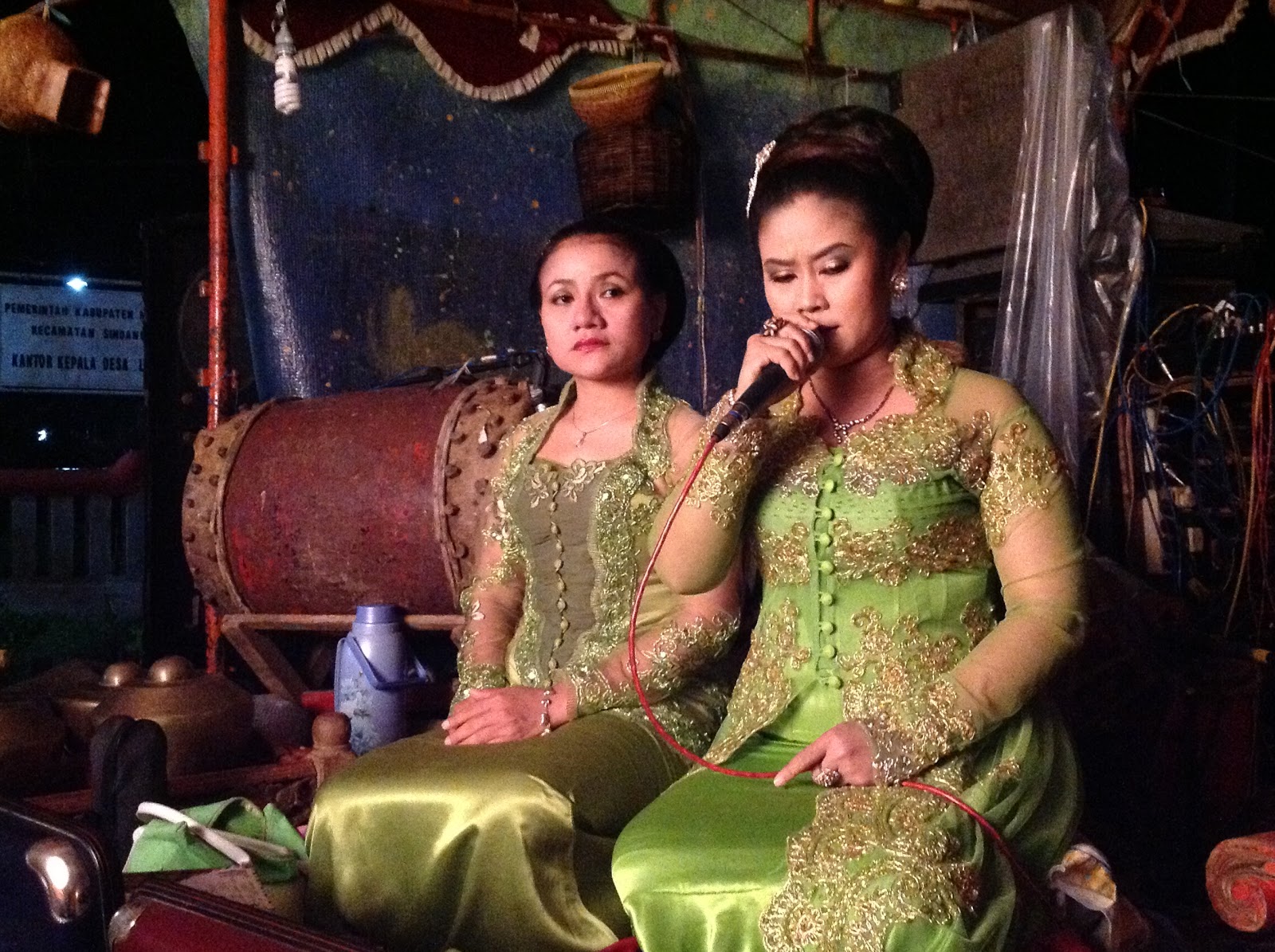
Sedekah Bumi in Majalengka are celebrated in style, and this was no exception. Not only was there an impressive range of gantungan hanging from the stage roof, including locally-crafted numerous containers that would be distributed among the musicians at the end of the show, the performance also featured the two most popular sinden in the Cirebon region, Itih and Iwi, who dressed in matching green outfits and sat on several layers of pillows through the show, like queens on their thrones.


The song requests started nearly as soon as Iti and Iwi arrived on stage and were constant until I left, fulfilled in medleys of four or five songs. The play, Purjadi warned me in advance, would take second place to the musical attraction on this occasion. The Bupati, who hailed from the nearby kecamatan of Ligung, where Javanese is also spoken and wayang kulit enjoyed, was scheduled to attend, but cancelled at the last minute as he had to appear before the governor. The audience was extremely attentive throughout - Purjadi commented to one of the musicians that if it wasn't for the fact it was so dark we would see a sea of faces around the stage. There were also a good range of vendors selling noodle soup, batagor, tahu goreng, bapao and the like.


As Purjadi predicted, there was not much drama on the screen last night. The play was Gatotgaca Nyungging (Gatotgaca Illustrated), an old branch story. In Purjadi's telling an ogre king's daughter is desired by many suitors and a sayembara or contest is established - whoever can defeat the king's minister will gain her hand. Before the contest has concluded, however, the princess tells her father to call it off as there is already someone special in her life. Her father the king asks what his name is and she says she doesn't know for she only had glimpsed him a dream. She draws the man of her dream (see photo above) and the king says he will now have to institute a new contest - whoever can bring this man to the court will receive a certain award. The dream man, as the title suggests, is Gatotgaca, who is also the object of other desires - specifically a descendent of Naga Percona who seeks revenge for his killing. At the time I left at 1.15am, the battle between the descendent of Naga Percona and Gatotgaca and the punakawan clown servants seemed about to start.

Purjadi, as always, did a fine job in singing sulukan and the puppet voices, and his puppet dancing has improved considerably in recent years, with tight coordination with the kendang player. Battle scenes were formulaic, however, and there was far less topical commentary than usual. He seemed less than inspired. Perhaps he felt that people weren't looking at him but at the sinden. I was tired and restless, and though I enjoyed playing with my iPad and displaying pictures I was taking to the musicians, sinden and spectators, in the end I left at roughly 1.15 am, more than 2 hours before the end of the show.

There were still lights on in the durian stands on the main road nearby, and I was tempted to stop by and try some. But I went back to my hotel instead.

Friday, December 21, 2012

Taman Budaya Yogyakarta: Malam Penganten and Wayang Orang Panca Budaya


Yesterday (20 December 2012) was my final night in Yogyakarta. I spent much of the day at Gadjah Mada University, meeting with colleagues and students and discussing possible future collaborations. At night, I had the opportunity of seeing not one but two shows at Taman Budaya Yogyakarta, the cultural centre in the middle of town.


The first show was a production of Minang writer Motinggo Busye's classic play Malam Penganten di Bukit Kera (1963; 'Honeymoon at Monkey Mountain') by a group of senior Yogyakarta actors, all of whom had been active in theatre in the 60s, 70s and 80s. The play briefly concerns a honeymoon of a couple in the house of the husband’s grandmother in a remote village. The wife is nervous about being in the countryside and agitated by the grandmother, an old crone obsessed with taking revenge on the murderers of her ex-husband. The husband is indifferent to her needs. Shots ring out and the husband says that his grandmother must have shot monkeys raiding her garden. The grandmother tells him to bring in the corpse, and it turns out to be a man, the same man she had promised to kill. The acting in this production was in the overwrought sandiwara style that ultimately goes back to komedi stambul, with huge gestures, declamations, illustrations of words with hands and so on. Everything, including the set and music and lighting, was polished and professionally delivered, but even though this sort of theatre is of interest to me as a researcher, I found this extended one act play hard to enjoy. The audience was small, and at the curtain call at the end there were nearly more people on stage than in the auditorium. Applause was lukewarm.


I then hopped over to TBY’s main hall, where a wayang wong production by WO Panca Budaya was under way. The goro-goro clown scene was playing when I entered, and the large audience chuckling merrily at the jokes of the clown servants. The play was Babad Alas Wisamarta (The Clearing of the Wisamarta Forest) starring the famous comedienne Yati Pesek in the role of Arimbi. The play was free of charge with invitations (which were easily available to fans from the TBY office and other distribution channels). TBY has been sponsoring a significant number of wayang wong and kethoprak shows at the end of this year- apparently there is money left over in the budget and these forms are easy to organise and always attract a crowd, especially when a well-known personage like Mbak Yati is involved.


Panca Budaya did a fine job in this play and was clearly in the audience’s favour. When Arjuna entered with a dead mike, Gareng made this into a comic bit, first circling around Arjuna so that bits of Arjuna’s dialogue were picked up by his own mike, then instructing Semar to sit next to his lord so that Arjuna could borrow his mike and so on. The fight between Arjuna and not one but two Cakil actor-dancers was masterfully executed. There was much hilarity after Kresna transformed the ugly Arimbi into a beautiful woman so that she might marry the powerful warrior Bima. Her younger brother and comic side kick, who earlier had mocked her for her ugliness and pretended to be Bima to spite her, fell for her and said that if Bima would not have her, he would.  The closing battle between the five Pendhawa and their doppelgangers was impressively choreographed, and the scene in which they merge, and the jungle transforms into the beautiful palace of Ngamarta and Yudhistira mounts the throne was wonderfully theatrical. A nice ending for my brief stay in the gudeg city. 

Pesta Boneka #3 (Day 3)

Wednesday 19 December was the third and final day of the third edition of the Pesta Boneka, a festival of puppet theatre being held this year at Padepokan Seni Bagong Kussudiardjo in Bantul, just south of the city of Yogyakarta.


It was a busy day for me. I started the day with a workshop with Drs. Suyadi (see photo above), best known to Indonesian viewers as Pak Raden, the creator of the famous si Unyil franchise. The 80-year-old puppeteer and illustrator Drs Suyadi had given a performance the night before, and while the workshop was scheduled to start at 9am he arrived only at 10am with his entourage. The nominal theme for the workshop was (in English) The Making of si Unyil, which involved participants sculpting a puppet head from papier mache.

Suyadi, who studied fine arts at ITB in the 1950s and then went to Paris in the early 1960s to study film animation, opened the workshop by explaining some of the principles of his glove puppets. Puppets, unlike dolls, are intended to convey character and used in stories, they cannot just look cute. All are intended to portray distinct and contrasting characters - with their own visual design, style of movement, voice and mannerisms. He compared his work to wayang kulit and did an impression of an exchange between Arjuna and Cakil, saying that wayang puppeteers would instantly know how to voice characters from their appearance. (I mentioned potehi later, and Suyadi enthused that this Chinese glove puppet form was the origin of all glove puppetry.)

The puppet heads are made from papier mache which is sculpted over a clay mould which is covered with vaseline. About 10 layers of paper are used. Then after the papier mache has dried (which takes at least a day) the head is cut in half (back and front), the clay taken out, ear made. A tube is inserted into the head. Then the head is laminated and coloured. Real human hair shouldn't be used - It would be frightening (mengerikan) to juxtapose the puppet as a dead thing (barang mati) with hair, which is a living thing (barang hidup). The hands, made from flannel and stuffed with cotton, are sewn to the costume. No padding is used so there are no fat puppets or thin puppets, but they appear to have different sizes based on movement and posture. You should have 4 fingers per hand not 5. Five would be too 'busy' (ribut). The middle finger is inserted into the head, the pinky into one arm, the thumb into the other.

Suyadi and his assistant spoke amicably with workshop puppeteers as we turned to make puppet heads using a simplified version of the method above. (No clay.)

At the end, participants received a book on puppetry (teater boneka) that Suyadi had illustrated which was published in 1970. One of the scripts mentions his character si Unyil, and has a drawing which resembles this beloved tv character. He also handed out a guide to copyright and a collection of stories about legal issues. Suyadi explained that the rights to si Unyil were no longer his. They belonged to Persusahaan Filem Negara, the national film outfit, and that these had been sold to private tv station Trans7 without consulting Suyadi, or any fee. Suyadi had mounted a legal case against PFN so that si Unyil might 'return to his father.' He said that he was not bitter about the case, nor did he want people's pity, but he wanted to issue a warning to creators of art (perupa) that they should be careful about copyright and make plans for rights well in advance. Suyadi appeared in full costume throughout the workshop, and was even wearing his false mustache and eyebrows when I ran into him and his party eating lunch later at Kedai Kopi.


Shortly after this workshop, I saw a 20 minute performance by the String Theatre, a young English marionette company, of their variety show The Marionette Insect Circus (see photo above). This was a charming little show with trick figures and old-time jazz. It preceded a string puppet making workshop for children, which was mostly attended by local kids of elementary school age. The kids were well behaved and attentive throughout.


In the evening, there were two more shows to attend. These were preceded by a spectacular dance accompanied by recorded gamelan. A group of boys did a well-executed monkey dance, dressed in a variant of wayang wong costume. Then dozens of children ranging in age from roughly 3 to 12 emerged in animal costumes of all sorts and did little turns. Clearly the parents were charmed.


This masquerade was followed by a short tabletop puppet show by a young Venezuelan stop motion artist and film maker named Angela  Stempel, who has been living in New York for the last 6 years. Stempel's work was based on a folk tale from Uruguay and followed the journey a man who is bitten by a poisonous snake and travels down a river to seek help. In the background film was projected that provided a setting and sometimes a commentary on the action. She was assisted in the building and performing of the show by a member of Papermoon. The show took about 2 weeks to make, and might be considered work in progress. In a post-show q&a, Stempel said that she considered this piece as a natural development of her stop motion work. Stop motion animation is very time consuming to make, and after 5 years of working in this medium she has been unable to break the 5-minute barrier. The figures she constructed for her piece were animated on a tabletop, like her stop motion figures, and thus were in a sense live stop motion, and would allow her, she felt, to create work of longer duration. The audience was restless for much of the performance, for although the English voiceover narration was translated in the projected film into Indonesian, the slow pace and lack of humour made the work difficult to appreciate.


The definite highlight of the evening for the popular audience was Wayang Hiphop, an extended goro-goro clown scene starring the punakawan (Gareng, Petruk and Bagong plus their father Semar) with Javanese language pop songs instead of gamelan. The creator of this new wayang kontemporer genre, which featured as an episode of the Sunday morning tv show World of Wayang this past autumn, is Catur 'Benyek' Kuncoro, a dalang I worked with in 2009 in a wayang bocor production based on the underground cartoons of Yogya-based artist Eko Nugroho. I had shown an excerpt of the WoW episode to my Royal Holloway students this autumn and they were generally nonplussed by this experiment. Some of the students said that the hiphop lacked in street cred, others found the blend of a classical Javanese art and pop culture to be contrived.

From what I saw at Padepokan Seni, Wayang hiphop remains at the experimental phase but growing in confidence. At the start, two groups of female dancers, one young and beautiful and one old and comic, danced to Javanese pop music. The dancers it seems were all associated with Padepokan Seni - when Wayang Hiphop had performed elsewhere local artists had also been incorporated. There was a story at the core of the show in which Petruk had been conned into paying 50 million rupiah to get his son Petrik a job, and then extracted money from Bagong who borrowed money from Gareng. During the course of the story, Petruk pays a visit to the police office to report the con. This was portrayed ingeniously through a projected background and the shadow of a policeman (played by an actor) and the sound of a clicking typewriter. (Other projections included images of central Jakarta -- the National Monument and the like -- and moneybags. Ambient sound was also used to convey the atmosphere of the city.) In the end, Semar is called in to settle the matter. Comic skits like this are common in wayang kulit, and other folk forms like ludrug and kethoprak, and Benyek is a good comic and the audience had no problem with the innovations he introduced, and clearly enjoyed the moments when the two male rappers and female singer emerged from behind the screen to sing, rap and participate in the comedy. Benyek moved easily between roles as MC, vocalist and puppeteer. His outfit - a combination of standard kejawen with dark shades and trainers -- got a laugh upon its initial appearance but seemed quite apt after a while. The audience responded enthusiastically to a quiz at the end in which questions were asked by Benyek (e.g. 'What are the name of Bagong's and Petruk's sons in Wayang Hiphop?') and received Papermoon and Wayang Hiphop merchandise when they answered correctly.

After the show, I had a chance to talk briefly with Benyek. He says that the story that night was new, though many of the devices had been tried before. He spoke also about how much of a pleasure it has been to collaborate with Mexican puppeteer Miguel Escobar, who has been doing participatory research on wayang hiphop towards his PhD at NUS. Miguel shows no compunctions about playing the role of the tourist in these shows, speaking crude Javanese on stage and generally being the butt of Benyek's jokes. Benyek says that people like Miguel and myself are critical for supporting his work - as he is a freelance dalang he doesn't have an institutional base and has had little help from institutions like Pepadi in creating his new work. The Ramadhan tour of Wayang Hiphop last August was a huge success - with 15 performances including devoutly religious places like Demak where wayang is very rarely to be seen. Many of these performances also were accompanied by proselytizing. In these plays, a preacher typically would show up and enlighten the nakal (naughty) hiphop artists and clown servants. Benyek said that he played the role of being nakal to the hilt as there was no point in him acting pious on stage as that dramatic role would be carried by a real preacher. When we parted we both admitted a desire to work together again. We'll see what form that collaboration takes.